Free · For Introduction to IoT by Misra, Mukherjee & Roy
The IoT syllabus, as a game you’ll actually finish.
Seventeen chapters told as one story, 496 questions that explain themselves, and hands-on labs where networks break, ciphers crack and sensors lie.
No sign-up needed to play. Make a free account to sync your progress and join the leaderboard.
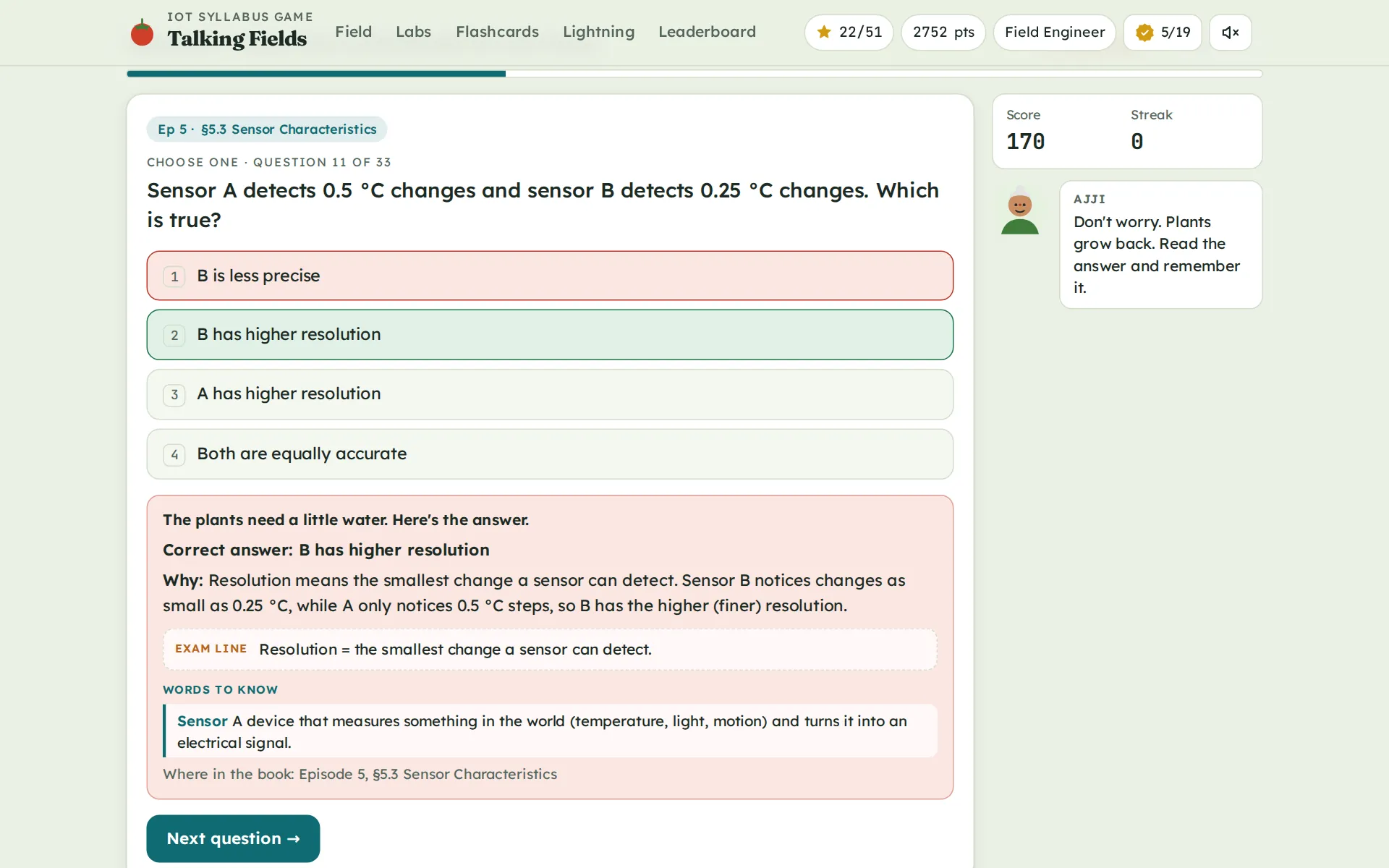
Every answer teaches
Wrong answers are where you learn the most.
After every question you get the reason in plain words, the exact line examiners look for, the tricky words explained, and the section of the textbook to reread. You never have to guess why.
- Section numbers match the textbook, so you can flip straight to the page.
- Keywords stay exactly as the book writes them, ready for your exam answers.
- Every miss goes into your mistakes deck, so you can fix it later.
Hands-on labs
Learn it by breaking it.
Twelve small experiments you can poke at. Each one has a mission and the textbook’s own rule beside it.


More ways to revise
Ten minutes before class? There’s a mode for that.
Flashcards
Word cards for the tricky terms and question cards with the reason on the back. Mark what you know; the rest comes back.
Lightning round
Sixty seconds, as many right as you can. Every miss is explained at the end, and your best score goes on the board.
Mistakes deck
Everything you got wrong, in one place. Fix a question and it leaves the deck for good.
The viva
Clear all seventeen episodes and Rao Sir calls you in: 25 mixed questions against the clock.
The whole syllabus
Seventeen chapters, one story.
Ira, a first-year student, promises her grandmother that the family’s tomato field will learn to talk. Each textbook chapter is one episode of that promise.
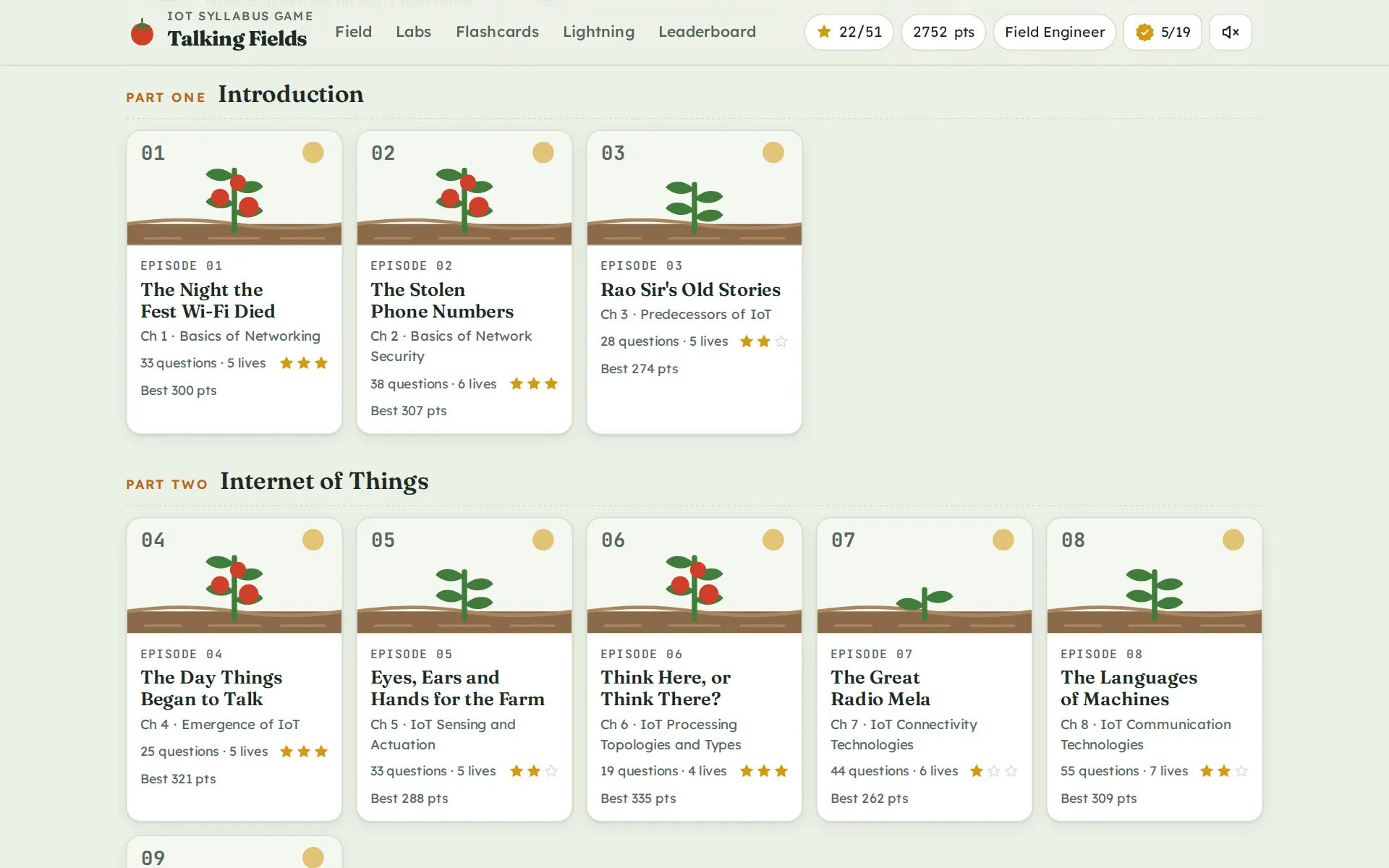
Part OneIntroduction
- 01The Night the Fest Wi-Fi DiedCh. 1 · Basics of Networking · 33 questions
- 02The Stolen Phone NumbersCh. 2 · Basics of Network Security · 38 questions
- 03Rao Sir's Old StoriesCh. 3 · Predecessors of IoT · 28 questions
Part TwoInternet of Things
- 04The Day Things Began to TalkCh. 4 · Emergence of IoT · 25 questions
- 05Eyes, Ears and Hands for the FarmCh. 5 · IoT Sensing and Actuation · 33 questions
- 06Think Here, or Think There?Ch. 6 · IoT Processing Topologies and Types · 19 questions
- 07The Great Radio MelaCh. 7 · IoT Connectivity Technologies · 44 questions
- 08The Languages of MachinesCh. 8 · IoT Communication Technologies · 55 questions
- 09The House of Many PlugsCh. 9 · IoT Interoperability · 28 questions
Part ThreeAssociated IoT Technologies
- 10Renting the SkyCh. 10 · Cloud Computing · 20 questions
- 11When the Cloud Comes Down to the FieldsCh. 11 · Fog Computing and Its Applications · 19 questions
Part FourIoT Case Studies and Future Trends
- 12Ajji's Talking FieldCh. 12 · Agricultural IoT · 15 questions
- 13The Night Bus to BengaluruCh. 13 · Vehicular IoT · 12 questions
- 14The Ambulance That Called AheadCh. 14 · Healthcare IoT · 15 questions
- 15Stories Under the Terrace SkyCh. 15 · Paradigms, Challenges, and the Future · 30 questions
Part FiveIoT Hands-on
- 16Lab NightCh. 16 · Beginning IoT Hardware Projects · 33 questions
- 17Teaching the Field to ThinkCh. 17 · IoT Analytics · 29 questions
Questions
Good to know
Is it really free?
Yes. Every episode, lab, flashcard and the lightning round are free, with no ads.
Do I need an account?
No. You can play as a guest and your progress stays in that browser. A free account keeps your progress safe, syncs it between your phone and laptop, and puts you on the leaderboard if you want.
Which textbook does it follow?
Introduction to IoT by Sudip Misra, Anandarup Mukherjee and Arijit Roy (Cambridge University Press). Every question is tagged with the textbook’s own section number, and keywords are kept exactly as the book writes them.
Is this an official resource?
No. Talking Fields is an independent study aid made by a student. It isn’t affiliated with the authors, the publisher or any university, and it doesn’t replace the textbook. Use it to understand and revise, then write your answers from the book.
What do you store about me?
Only what the game needs: your email and display name if you sign up, and your game progress. Read the privacy page for the details. You can delete your account and data from the account page at any time.
Found a mistake, or have a question?
Write to thanmaikarkera@gmail.com. Tell us the episode and question, and we’ll fix it.
Does it work on my phone?
Yes. The site works in any modern browser on phones, tablets and laptops.